There's no perfect moment
And we're not perfect either

Most of us are waiting for that perfect state from which we can start and thrive. Start a podcast, a business, a relationship, a drawing class etc. We want to have financial stability, emotional clarity, close to zero unpredictibility, no trade-offs, only benefits. We want God to wait for our call and the moment we speak our intention, the heavens would open and pour goodness onto us. It's natural to want your life to be in order. The real problem is our increasing inability to take action.
I know, the phrase 'take action' has become cliché, especially with so many influencers profiting by motivating others to simply make money. However, taking action is truly valuable advice.
In our hearts, we hear the yearning of exploring the multiple dimensions of life, but society clearly told us that we need to over specialize in something to have value - more about this in a future writing - so we don’t even have the courage to listen to ourselves. We just close the heart in a cage and throw the key away so we don’t hear the drip - drip - drip of our needs. Moreover, we have access to a vast range of experiences, something unprecedented in human history. We used to have a very small subset of aspirations and now the world seems to unroll and unfold at our feet for us to walk on it. Before starting to walk though, we want to have, among another infinity of things, perfect shoes for all terrains, a concrete map and a fully charged phone - how else can you find out where to go in life other than having a device that tells you exactly every turn? I’m sarcastic, of course. We completely threw away intuition, risk, curiosity and trully, fun. We want perfection or nothing. And that usually gets us the farthest thing from perfection.

There’s a solution
The solution can be found in mathematics, specifically in machine learning. It's called gradient descent. Interestingly, much of modern computer science is based on our understanding of human cognition, but I'll delve deeper into that in a future post.
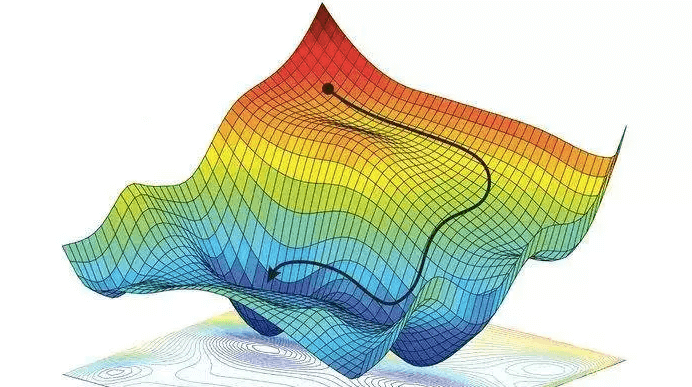
What’s the trick that gradient descent uses? Instead of striving for perfection or complete knowledge, the decision-making entity simply acknowledges its current position (self-reflection). It abandons the need for certainty and takes the most direct path towards minimizing costs (maximizing desired outcomes). Imagine going down a valley and taking only small steps in the direction that gets you faster to the bottom.
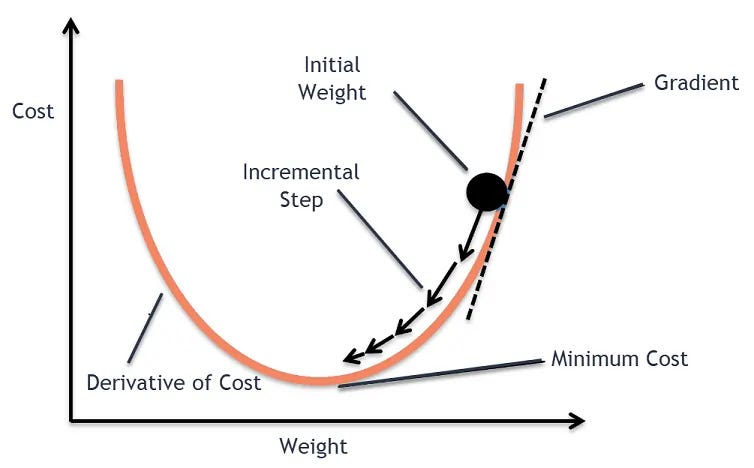
Why is gradient descent better than trying to perfectly analyze and understand everything before taking a decision?
Computational cost: Striving for perfection is mentally exhausting. We don’t want our brains to hurt.
Memory constraints: Our brains constantly prune information to make space for new experiences.
Convergence: We’re more likely to get to the desired outcome through consistent smaller steps than through a single time huge effort. Also, taking a huge step might break your back if the valley is steep enough.
The anxiety ends when you start moving
I’m not in any place to give anyone advice, but my recommendation is to not wait for every single dependency you think might lead you to success. Trying to trace everything back to its origin is an endless and ultimately futile pursuit. What was there before the universe started? Nothingness? We don’t know, but for sure it’s not waiting for us, so we must act quickly. The present moment is all we have.
This post was inspired by an episode of Vorbitorincii, featuring Cristian Presura, which I highly recommend. They discussed the tendency of Romanian people to fixate on a perfect starting point ('T0') instead of embracing the power of incremental progress.
Reflect on your current situation, identify the next best step, and take action to move towards your goals.
No more waiting for the perfect moment! - Radu, while writing this post
This Substack is live, and I'm committed to posting weekly (or at least I'll try my best!). Subscribe for a dose of whatever I’ll write - hopefully, more hits than misses!
PS: Mom, Dad, sorry for writing in English. I love the Romanian language as much as you do and I promise to help you with the translation.