God in Disguise
The Creative Power of the Present Moment

The Trap of the Past
We've all been there. That nagging feeling of regret, that persistent "what if" that echoes in the quiet moments. Maybe it's a harsh word spoken in anger, a chance not taken, a path not followed. It's easy to feel like our past is a heavy chain, each link forged by our mistakes and missed opportunities, dragging us down and dictating our present.
It's a natural human tendency to view our lives as a linear progression, where the past inevitably shapes the present. We believe we are the sum of our past experiences, for better or worse. This perspective, while seemingly logical, can become a prison of our own making.
The Conventional View: Past as Architect
We often think of time like a river, flowing relentlessly from the past, through the present, and into the future. Every event, every decision, every circumstance in our past is like a pebble dropped into that river, creating ripples that inevitably reach the present moment. This makes sense, doesn't it? Our childhood experiences shape our personalities. Our past successes build our confidence (or lack thereof). Our past failures teach us lessons (or leave us with scars). It seems obvious that the past is the architect of our present reality.
Present as Creator
But what if we've got it backwards? What if, instead of the past creating the present, it's the present that's constantly creating – not just the future, but also our very understanding of the past? Philosopher Alan Watts offered a radical alternative to this conventional view of time, suggesting that we are far more powerful, and far more responsible for our experience, than we typically believe. The rock band Nothing More, through their powerful consecutive pairing of the songs SIGHT and STUCK from the album CARNAL, helped me connect more deeply with these profound insights from Watts, and I'm grateful for their artistic expression.
Alan Watts on Time
Watts masterfully used the metaphor of a ship and its wake to illustrate this point. He invites us to reconsider our fundamental assumptions about time itself:
"We think ordinarily of the present as an infinitesimal point at which the future changes into the past. And we also do a terrible thing. We imagine ourselves to be results of the past."
This, Watts argues, is where we fundamentally misunderstand our relationship to time. We see ourselves as passive recipients of the past's consequences, forgetting our active role in shaping our present, and therefore, our past. He continues:
"We don't realize that the past is caused by the present, as the wake of a ship flows back from the prow. Now, the wake doesn't drive the ship any more than the tail wags the dog."
The wake is a consequence of the ship's forward motion, not the cause of it. Our present choices, actions, and, crucially, our interpretations create the narrative we call 'the past.' It's not a fixed, immutable entity, but a constantly evolving story we tell ourselves, shaped by our present perspective.
It is because of our excuses that we avoid the truth. What is the truth? Watts states it clearly:
"But the truth of the matter is it all begins here. This is where the creation begins. And you are doing it and won't admit it. Because, of course, you're all God in disguise. Jesus found that out, and they crucified him for saying so."
This is a bold, even provocative statement. Watts is suggesting that we possess a creative power we often deny. We are not merely products of our past; we are active participants in the ongoing creation of our reality, including our understanding of what has come before.

The Illusion of Time: A Cosmic Perspective
Our concept of linear time is, in many ways, an artificial construct. We measure time in relation to the Earth's rotation around the sun, a convenient but ultimately arbitrary system. Consider the vastness of the universe. Stars are born and die over unimaginable timescales. A star's light might reach us centuries after its death. Did that star exist 'before' or 'after' a specific event in your life? The question itself reveals the limitations of our linear time framework. There is, in a profound sense, only now. The past and future are mental constructs that exist only in our present awareness.
Empowerment and Responsibility
So, what are we to make of this radical shift in perspective? It's not about denying the events of the past, nor is it a simplistic call to 'live in the moment' without any consideration for consequences. Instead, it's an invitation to deeply contemplate our relationship with time and responsibility.
If the present moment is the point of creation, what kind of creation are we choosing? Are we perpetuating old patterns, replaying old hurts, and reinforcing limiting beliefs? Or are we approaching each moment with fresh eyes, open to new possibilities, and willing to rewrite the narratives that no longer serve us?
The implications are profound. It suggests a level of freedom that can be both exhilarating and terrifying. Exhilarating because we are not bound by the chains of the past. Terrifying because we can no longer hide behind the excuse of circumstance. We are, as Watts suggests, the authors of our own experience, constantly creating and re-creating our reality.
This isn't a call to action in the traditional sense, but a call to awareness. A call to observe, with unflinching honesty, how we are shaping our present – and therefore, our past and future – with every thought, every feeling, and every choice. What stories are you telling yourself right now? What reality are you creating?
The Power of Now
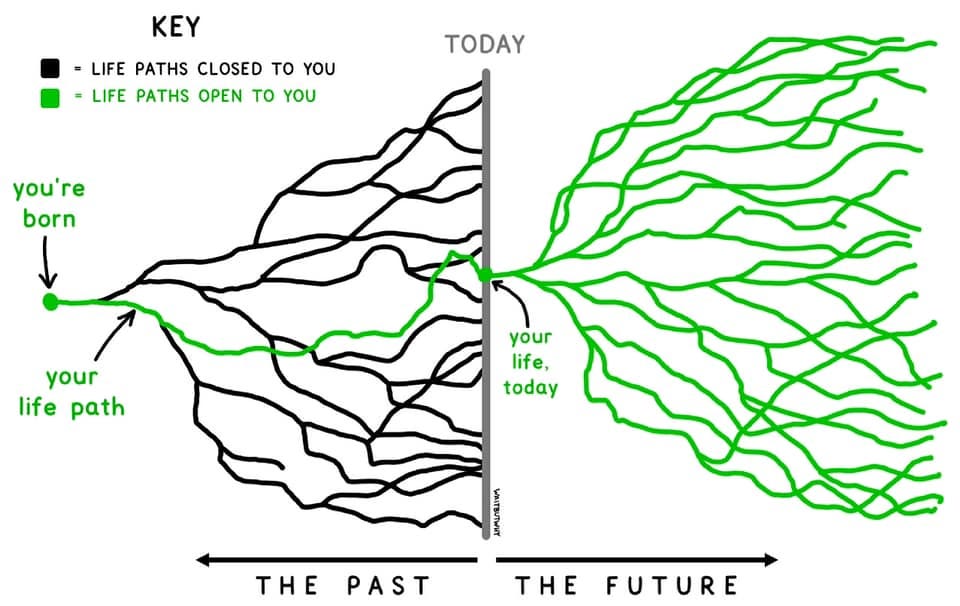
The past may have shaped the landscape of your life, but it doesn't determine your destination.
The present moment is the point of power, the engine of creation.
By recognizing the profound implications of this, by truly understanding that the wake doesn't drive the ship, we open ourselves to a deeper, more authentic way of being. We begin to live, not as victims of circumstance, but as conscious creators of our own unfolding story.
enlightening